
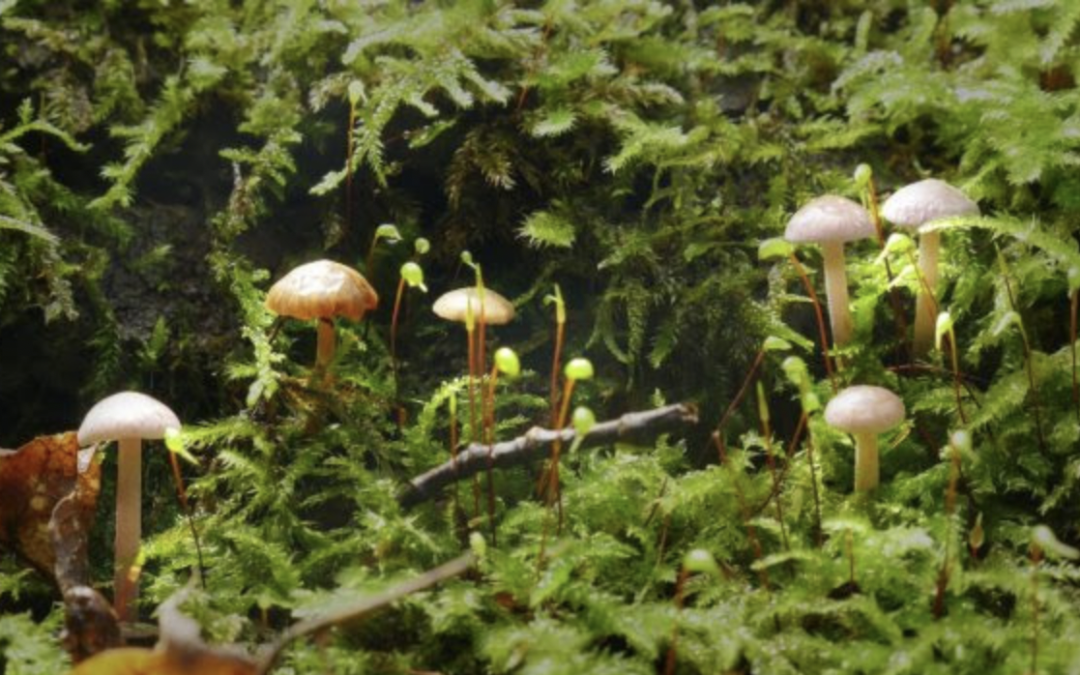
Lithuanian non-profit organization the Ancient Woods Foundation, which takes firm steps in reducing deforestation in the country by preserving biologically unique old-growth forest parcels, has discovered a rare mushroom type in one of the forests under the organization’s protection—Lavender Baeospora (Baeospora myriadophylla).
According to Dr. Reda Iršėnaitė, a mycologist who discovered the fungus and works closely with the Foundation, this is a scientifically momentous finding since it is the only known habitat of the fungus in Lithuania and one of the only 400 habitats in the world—several of which are drastically decreasing due to deforestation and climate change.
The rare mushroom habitat in Lithuania could have been easily destroyed by logging. The Ancient Woods Foundation bought out the almost 50-acre Moniškis forest parcel just in time to save it, meanwhile, another valuable parcel next to it was entirely cut down.
Incentive for forest preservation at the national level
The Ancient Woods Foundation is preserving biologically valuable forest parcels with all life forms in them. The organization is creating an ancient wood that allows a variety of organisms—over 15k—to live and prosper unobstructed by human activity.
“A multitude of trees of varied ages and kinds grow in the ancient woods, creating an ideal habitat for thousands of species which need different conditions to live. Only biodiversity found in old-growth forests can ensure an “evolution reactor” that would allow the forests to change, adapt, and survive even with climate change happening right now,” Mindaugas Survila, a renowned documentary filmmaker, who co-founded the Ancient Woods Foundation, said.
According to Mr. Survila, the sixth mass species extinction has already started, and the loss of ancient woods has caused fungi like Lavender Baeospora to become extremely rare.
“Lithuania has many biologically valuable forest parcels, which create conditions for species like this to prosper. The rapid deforestation might further cause many of the endangered species to go fully extinct if no action is taken. Therefore, the Foundation hopes to buy out as many such parcels as possible and let them be untouched,” he added.
Mixed forests protect endangered species
The fungi variety is extremely important for all ecosystems because it interacts with other organisms like mycorrhizal and endofit fungi and provides food and water to humans. Baeospora myriadophylla is a saprotrophic fungus that feeds on wood and grows on giant decomposing firs, maples, alders, or, in some cases, on decomposing aspen trunks.
The species has been listed as endangered on national Red Lists of ten European countries while its habitats decreased by 15-25% within the last 50 years due to old-growth wood destruction. Scientists presume this decrease will continue in the future, therefore highly endangering the fungus. The last example of this species in Lithuania was found 50 years ago.
Dr. Reda Iršėnaitė says that Moniškis forest parcel had ideal unique conditions for the Lavender Baeospora to grow. There are many old aspen trees, which are especially valuable for decomposers like fungi, insects, and animals.
“The fungus is small but exceptional and very important to the forest ecosystem that takes a million years to develop. The decomposing aspen trunks preserved are a biodiversity treasure. The fungus probably would not have survived had the Ancient Woods Foundation not preserved this forest parcel. It is not included in the Lithuanian Red List as there have been no remaining examples of its habitat up until now,” she added.
The Foundation notes that large old mixed wood plots full of dead wood and organism variety may slow down biodiversity loss. For instance, Moniškis parcel has 130-year-old oaks, dead wood, and rare flora, fauna, and fungi species: a beaver house, signs of ungulate activity, and the habitats of white-backed woodpeckers and grey-headed woodpeckers listed as endangered species. The mycologist also found a crown-tipped coral (Artomyces pyxidatus), which grows on old decomposing aspens, tree lungwort (Lobaria pulmonaria), thriving on steady habitat conditions and clean air, as well as other kinds of lichen, moss, and fungi.
More information about the Ancient Woods Foundation, the means of contribution, and its achievements is available here.