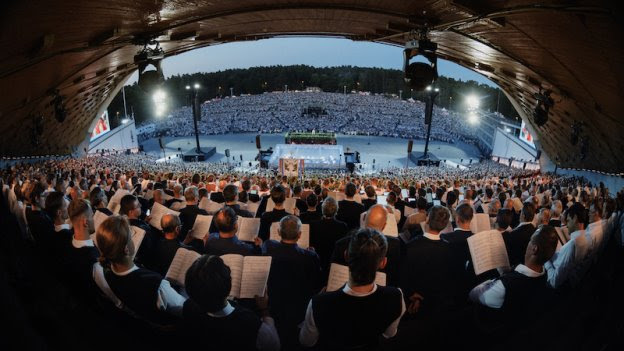
The 100th Lithuanian Song Celebration, a week-long UNESCO-recognized event marking its centennial, concluded with a grand finale on July 6 at Vingis Park in Vilnius featuring 12,000 performers on one stage. In 2008, the Lithuanian Song Celebration was inscribed on the UNESCO Representative List of the Intangible Cultural Heritage of Humanity.
Throughout the week-long event, there were 37,000 performers, 1,500 ensembles, and 100 conductors, with a program encompassing 40 hours and featuring 14 concerts and events.
Approximately 2,000 Lithuanian expatriates came back home to perform at the Lithuanian Song Celebration. There were 24 groups from the USA, 7 from Canada, and 14 from neighboring Poland.
“The Lithuanian Song Celebration holds a truly special place in the hearts of Lithuanians – it helps us reconnect with each other and with our roots and gives us strength for whatever challenges may lie ahead. During the Celebration week, events like Dance Day featuring 9 thousand dancers or Song Day featuring 12,000 singers showed how strong and united we are,” said Saulius Liausa, Director of the Lithuanian National Cultural Center, which organized the Lithuanian Song Celebration.
The Lithuanian Song Celebration is known as a symbol of the nation’s resilience and cultural identity. In the 20th century mass choral singing acquired widespread popularity as a way of asserting Lithuanian cultural identity through the tradition passed down from generation to generation. It gained prominence during the Singing Revolution of 1987-91, when Baltic nations defied Soviet rule through music – at that time, a new national awakening took place, characterized by the spontaneous singing of thousands in mass rallies.
The scale and cultural significance of the Lithuanian Song Celebration is unparalleled globally, akin only to similar events in other Baltic nations.