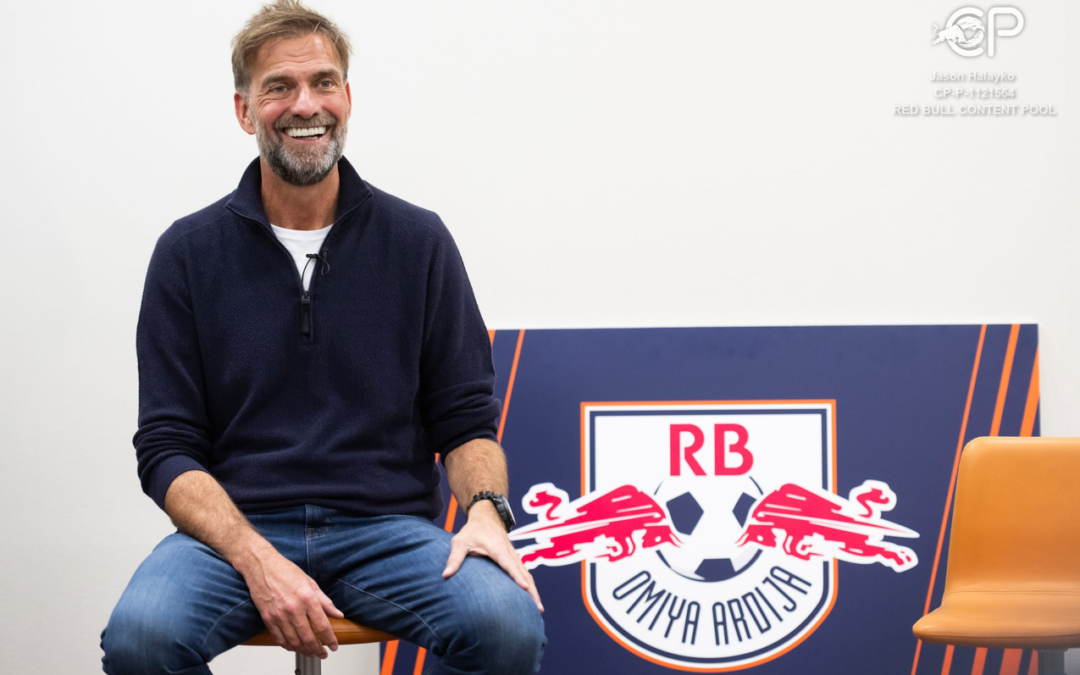
One year after stepping into his role as Head of Global Soccer at Red Bull, in an interview with The Red Bulletin, Jürgen Klopp reflects on how optimism is shaped by realism, why failure serves as information rather than a stopping point, and how belief becomes powerful only when it is shared. In the conversation, Klopp also addresses how leaders learn to filter pressure and public noise, what has changed in his leadership beyond the touchline after 12 months in the role, and why patience and long-term development remain essential in modern football.
On optimism in uncertain times
Q: There is a sense of unease about the future in many parts of the world. How are you feeling personally?
I’m very optimistic. That’s how I approach the future. Of course, that doesn’t apply to every aspect of life or to everything happening in the world. Everything is changing. Many resources we long believed to be infinite are becoming scarcer and more expensive for all sorts of reasons, and a lot of things are simply beyond our control. That’s the point: I’m optimistic about the things I can influence. With everything else, events and trends, you have to live with them and somehow deal with them.
Q: That sounds easy to say.
Of course, many people suffer far more than I do, given my privileged position. I’m aware of that. I’m sitting here at 58, having lived a life I wouldn’t have dared to dream of as a young man. A lot has gone very, very well. But 40 years ago, I was already the same person, with the same values. You could call that groundless optimism. I always believe it will turn out well.
On realism, talent and elite sport
Q: Do you have to be an optimist to succeed in elite sport?
I loved the game deeply and was one of the best in the region. But even back then, the realist in me knew I wasn’t good enough. Maybe I underestimated myself a bit. I had a very average professional career, and that career made everything afterwards possible. I certainly wouldn’t be the coach I am today if I hadn’t dragged myself through 325 matches in German second-division stadiums. You really do need optimism to fulfil your dreams. It makes the time while you’re pursuing them more enjoyable. But realism matters too. What are my talents? Where can I make a difference? Pessimism alone is useless.
On failure as information
Q: Why do setbacks never seem to stop your momentum?
Pessimism usually stems from past experiences where things didn’t turn out as hoped. That experience often leads people to stop believing in what they might achieve in the future. For me, things that didn’t work in the past are simply information that they didn’t work. I never allowed that to hold me back beyond the failure itself.
On shared belief and collective energy
Q: How do you ignite belief in a team, a club or even an entire city?
Everything has its time: grief, anger, reflection. The worst defeats of my life were the missed promotions with Mainz. After missing promotion the second time, I stood on a stage and said that maybe the football god was running an experiment on us — whether you can fall not just once, but twice or even three times and still come out stronger. I said there is no better club and no better city than Mainz for this experiment. In that moment, everyone believed it. The players, the fans, everyone. At the first training session, 10,000 people showed up. Optimism on its own is nice. But when you share it with others, it has a truly powerful effect.
On pressure, noise and public debate
Q: How should leaders and coaches deal with public pressure and external criticism?
The biggest driver in sports is public pressure. Coaches already put enough pressure on themselves. How do you react to a public debate? Not at all. If I were to write a book, it would be very short: just ignore it. One sentence in 200 pages. We want to play the best possible football and achieve our own goals, not be dictated to by others.
On leadership beyond the touchline
Q: What has changed for you after one year as Head of Global Soccer at Red Bull?
I don’t miss the changing room. I was there often enough. The first year was incredibly intense. We initiated a lot of things and broke down old patterns. I didn’t arrive and tell people on day one what they needed to do differently. I want to know who I’m dealing with, what they’re doing and why. Then we can talk about changes and improvements. My role now is to be a partner for our coaches — someone they can call when they need perspective, because I’ve been in the same situation.
On sustainable development in modern football
Q: How do you balance immediate results with long-term development in today’s game?
Of course, you have to solve the immediate problems. But development takes time. I’ve always assumed that I’ll be somewhere for a long time — not because I’m overly optimistic, but because that’s my way of thinking. I want to get to know people, understand things, have an impact and then hopefully be successful. Whether that takes seven, ten or twelve years doesn’t matter.
Q: Can optimism be trained?
My outlook on life is based on reflecting on the things that have happened to me. No one ever told me how to deal with setbacks. That was my decision. When I look at where I come from and where my career has led me, it feels almost impossible. I hoped my decisions were right, and then the next time, I was ready to risk everything again.
Why It Matters
In a climate of constant scrutiny and compressed timelines, Klopp’s perspective reframes optimism as a leadership discipline rather than a personality trait. His reflections offer insight into how belief, patience and resilience scale from individual teams to global organisations, and why long-term thinking remains critical in high-pressure, results-driven environments. |