
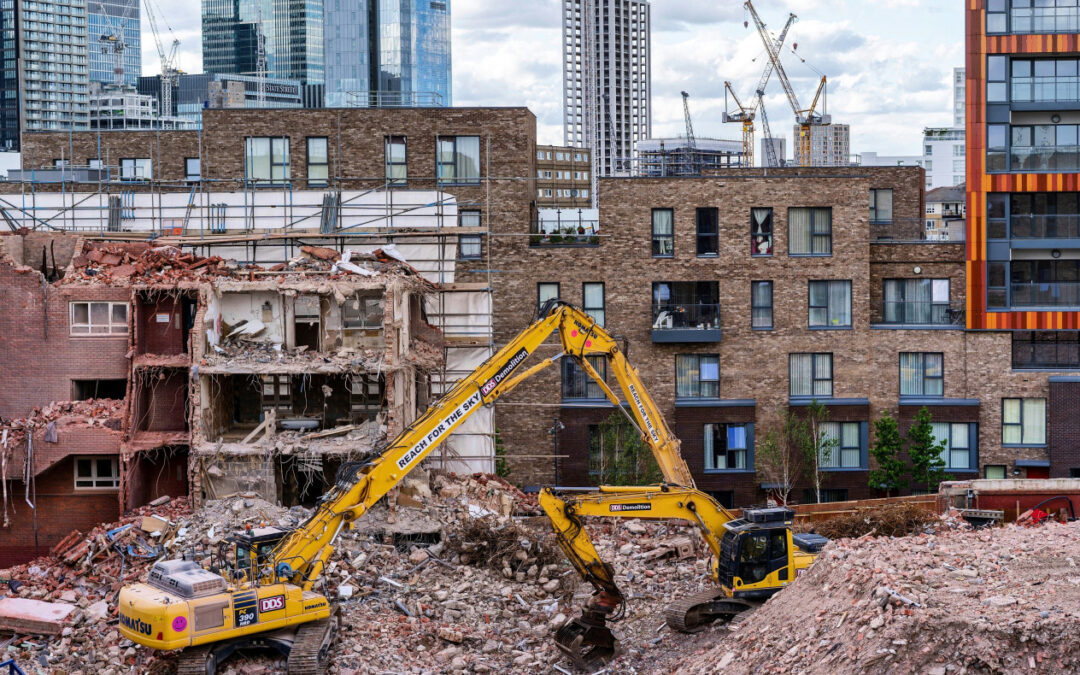
Building is often seen as a sign of progress: new homes, modern buildings, better infrastructure. But before something new can be built, the old often has to go first. Across Europe, large numbers of buildings are demolished every year. And surprisingly often, they are not ruins, but buildings that could still be used.
Demolition is about far more than a building simply disappearing. It also means losing materials that have already been produced and built into it: concrete, steel, glass, timber and masonry. Many of these materials could be reused or recycled. Instead, demolition generates huge amounts of construction and demolition waste. In the European Union, this sector accounts for more than a third of all waste. According to the European Commission, around 124 million tonnes of waste were generated by demolition alone in 2022.
Much of this is not actually worthless waste. Building materials could be reused or recycled. But that requires them to be separated, processed and used again. In practice, a lot of materials end up in landfill or are not reused to their full potential. The problem is particularly serious when hazardous substances such as asbestos are disposed of improperly. They can contaminate soil and water, posing risks to the environment and human health.
There is also the issue of climate change. Demolishing a building and then constructing a new one requires large amounts of concrete, steel and other building materials. Producing them is energy-intensive and generates CO₂ emissions. According to estimates by the NGO German Environmental Action, demolition and new construction alone produce around 3.3 million tonnes of CO₂ a year in Germany. Some of these emissions could be avoided by renovating and continuing to use existing buildings.
Renovation does not necessarily mean completely reinventing a building. New windows, better insulation or a modern heating system can make an old building far more energy-efficient. At the same time, much of the existing structure can be preserved.
This is particularly relevant in the context of Europe’s climate targets. The European Green Deal aims to make Europe climate-neutral by 2050. Buildings play a central role in this effort: they account for a significant share of energy consumption and greenhouse gas emissions in the EU.
At the same time, according to the European Commission, around three-quarters of Europe’s building stock is currently considered energy inefficient. The EU is therefore placing greater emphasis on renovating existing buildings. Its so-called Renovation Wave aims to increase renovation rates and make buildings more energy- and resource-efficient.
The goal is clear: Europe is to become more climate-friendly, and its buildings need to become more energy-efficient. Since May 2026, new EU rules on the energy performance of buildings have therefore been in force. Member states are expected to gradually modernise their building stock and achieve a zero-emission building stock by 2050.
But this creates a tension. Climate action is not only about how much energy a building consumes while it is in use. Demolishing it and producing the materials needed for a new building also generates emissions and consumes resources.
So why is demolition still so common?
There is no simple answer. For property owners and investors, new construction can be economically attractive. A site may allow for more floor space to be built. Modern standards can be incorporated from the outset. And in some cases, building new really does make more sense than renovating.
But the calculation does not end with the price paid by an investor.
Society also bears part of the cost: through resource consumption, CO₂ emissions and the disposal of construction waste. And for people living in a building, demolition can mean losing their home.
Building scientist Lamia Messari-Becker therefore advocates a stronger culture of adaptation and reuse. What matters, she argues, is not simply how old a building is, but what standard it needs to meet and what it needs to be used for. New construction may appear more economically attractive because certain standards are easier to achieve and additional floor space can be created. But such calculations do not always take environmental and social costs sufficiently into account.
Renovation can also strengthen the local economy. While a large share of spending on new construction goes towards materials, renovation and conversion require more skilled labour. Local businesses can benefit from this.
And preserving buildings can also be important for tenants. Europe is facing a shortage of affordable housing. Between 2015 and 2025, rents across the European Union, Norway, Iceland and Switzerland rose by an average of 21.1 per cent, according to research by CORRECTIV.Europe earlier this year. When affordable existing homes are replaced by more expensive new buildings, it can put additional pressure on the housing market.
The question of demolition and new construction is therefore also a question of political choices and regulation. The EU wants to accelerate the energy renovation of its building stock. At the same time, reliable data on how many buildings are actually being demolished is still lacking.
This leaves a fundamental question: Why do we so often build new when there is already so much existing building stock? If demolition and new construction are economically attractive for individual actors, while the costs of waste, resource consumption and CO₂ emissions are borne by society as a whole, then we need to ask whether the incentives are right.
A sustainable building policy should therefore pay greater attention to what is already there. Not every old building can or should be preserved. But before the wrecking ball hits, one question should be asked: What can we reuse?
Because every demolition takes more than concrete with it. It takes resources, energy and materials – and often a piece of a city’s history. The building transition could therefore begin less with the question of what we want to build next, and more with the question of what we can preserve. — Lilith Grull, international Reporter, CORRECTIV