







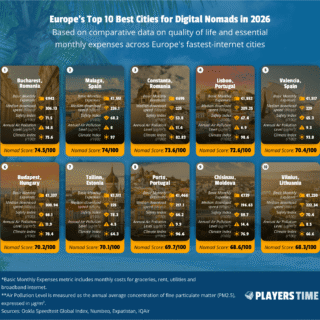














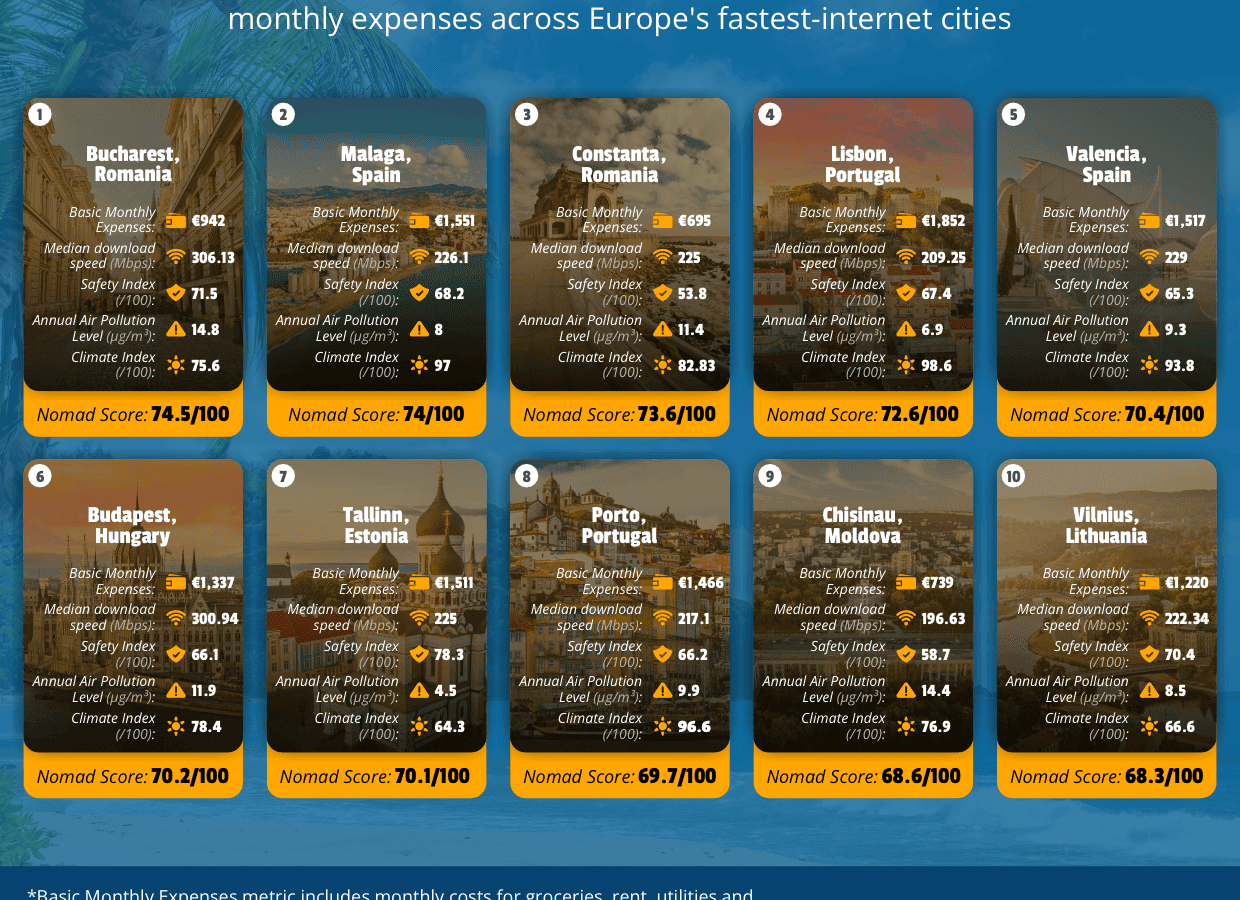

To find Europe’s ultimate remote work hubs, the team at Players Time compared the 49 European cities with the fastest fixed broadband connections, evaluating them based on equally weighted metrics: internet speed, rent, utilities, food costs, public transport, broadband prices, safety, climate, and air pollution. Data was sourced from Ookla Speedtest, Expatistan, Numbeo, and IQAir, with the full dataset created for this ranking available on Google Drive via this link.
The findings show that Warsaw is Poland’s best-ranked city for digital nomads, placing 16th out of 49 European cities with a Nomad Score of 34.1/100, followed by Kraków in 20th (63/100) and Wrocław in 28th (59.4/100). All three are among the 10 safest cities in the analysis, yet also among the 10 most polluted, with Kraków recording the dirtiest air of all 49 cities.
Here are some key takeaways from the report:
- The Polish capital Warsaw is the country’s best city for remote workers, coming 16th out of 49 European cities with a Nomad Score of 64.1/100. That puts it ahead of some of Europe’s most sought-after capitals: Copenhagen (18th), known for its high quality of life, Vienna (26th), often named one of the world’s most liveable cities, as well as Rome (30th) and Amsterdam (34th).
- Kraków and Wrocław offer big-city life at a lower price. A month in Kraków costs €1,549 and in Wrocław €1,583, around €400-450 less than in Warsaw (€2,002). Both are also cheaper than popular digital nomad hotspots Lisbon (€1,852) and Barcelona (€1,774), as well as nearby Prague (€1,664). Kraków has the lowest monthly food bill of the three Polish cities (€404), while Wrocław has the lowest rent (€912 for a furnished studio).
- Polish cities are among the safest in the study. Kraków scores 75.2/100 on the Safety Index, Wrocław 74.9, and Warsaw 74.6, putting all three in the top 10 of the 49 cities. That is ahead of Amsterdam and Copenhagen (both 74.3) and far ahead of Paris (42) and London (44.4), so walking home after dark is far less of a worry.
- According to IQAir data, Kraków has the most polluted air of all 49 cities in the study, with yearly fine dust levels almost double the EU’s new limit for 2030. Wrocław and Warsaw are also among the 10 most polluted cities, and all three are above the EU limit. A big part of the problem is likely home heating, as many Polish households still burn coal and wood in winter. Kraków also sits in a valley surrounded by hills, which can trap smog over the city on cold, still days.
- A monthly public transport ticket costs €37 in Warsaw, €38 in Kraków, and €44 in Wrocław. The lower price doesn’t come at the expense of quality either: in Time Out’s 2026 survey of locals, Warsaw ranked 6th in Europe for public transport. It’s the same story online. All three Polish cities are among the seven cheapest in the study for home internet, and according to Ookla, Kraków (235.48 Mbps) and Warsaw (234.34 Mbps) even have faster connections than two of Europe’s biggest business hubs, Paris (216.28 Mbps) and London (156.71 Mbps)
Most digital nomads are paying extra for a filter. They queue for the same cafes in Lisbon and Barcelona, while some of the safest and best-connected cities in our study sit in Poland, and hardly anyone talks about them. Warsaw ranks ahead of Vienna, Rome, and Amsterdam, and all three Polish cities feel safer than Paris or London. If that surprises you, you’ve been reading the wrong travel guides.
Poland isn’t trying to sell you a sunset. It just gives you what you actually need to work: fast, cheap internet in Warsaw and Krakow, a travel pass for less than half the price of one in Paris, and streets where you don’t have to look over your shoulder. Remote work was supposed to be about freedom, not about paying more to live where everyone else does.’
– comments Diliana Hristova, data analyst and author at Players Time.

All Inclusive
Luksusowy kwartalnik turystyczno-podróżniczy. Od 2004 roku opisujemy miejsca, do których warto lecieć dłużej niż na weekend, i ludzi, którzy je prowadzą.