
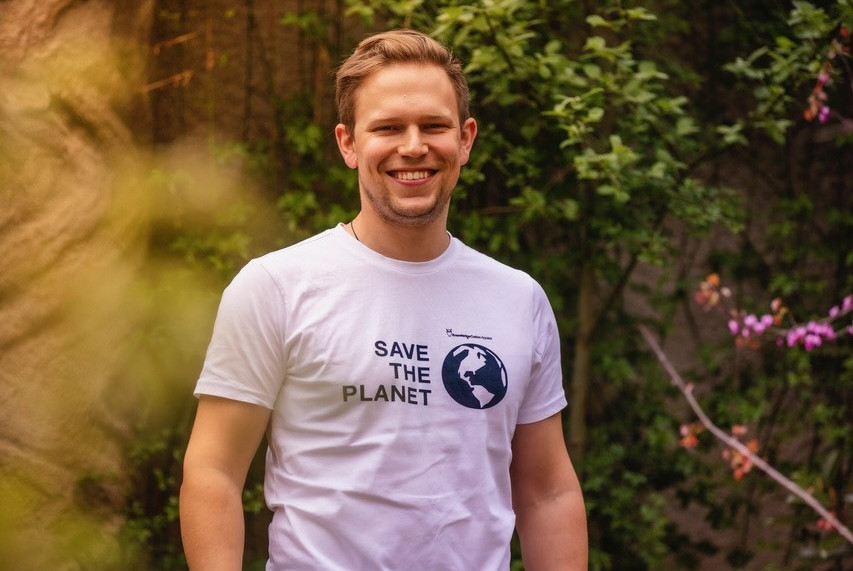
My parents used to be labeled as 'green nutcases,’ and I may be making a fool of myself as a speaker today. But the truth is: we can’t save the world on our own.
Ben Förtsch, Owner of the Hotel Luise
Benjamin Förtsch of the Hotel Luise is considered one of the pioneers of sustainable hospitality in Germany. Most recently, his hotel was awarded the German Sustainability Prize. For decades, Förtsch has developed concepts such as the Nachwachsende Hotelzimmer® (Renewable Hotel Room) and has thought radically ahead in terms of the circular economy. Yet he says, „Sustainability is bullshit.” We wanted to know why.
An empty shell
Green Pearls®: Ben, you’re being awarded the German Sustainability Award, yet you say you can’t stand hearing the word “sustainability” anymore. What’s going on?
Benjamin: The word has become an empty shell. Within the bubble, it can mean a thousand different things. Outside the bubble, it’s annoying and has negative connotations. I would prefer to delete it completely.
Green Pearls®: But without the term, isn’t there a lack of common ground? How can we talk about our responsibility toward future generations and the health of the planet then?
Benjamin: Perhaps by no longer talking about “sustainability,” but rather about resilience, economic efficiency, and future viability. Try replacing “sustainable hospitality” with “economical hospitality.” Every functioning business already fulfills one of these pillars. Those who work in an ecologically smart way reduce costs. Those who work in a socially fair manner solve the shortage of skilled workers. This is not a niche – it is business logic.
Is the hotel industry even relevant when it comes to climate change?
Green Pearls®: Nevertheless, the accusation remains: Hotels consume more energy and water and produce more waste than private households. Consider the buffets, wellness facilities, and lighting. Is sustainable hospitality a contradiction in terms?
Benjamin: That’s like comparing apples to oranges. Do you have a buffet and a wellness area at home? A hotel can actually be more efficient because its processes are streamlined. Furthermore, hotels are test labs and showrooms. The question is: How are you going to use it? I am convinced that guests at our Hotel Luise have a positive impact.
Green Pearls®: However, a trip’s greatest effect on the climate does not come from the hotel itself, but from the journey to and from the destination. What do you think? Isn’t a hotel’s impact limited in this respect?
Benjamin: Of course, it is limited. As a hotelier, however, you can also consider which target group you want to appeal to. Do my guests add value to the region? Do they interact with the value chain? Hotels have a responsibility to establish these connections. I once attended a presentation by a steel mill. They said that by optimizing their trace heating for just a few hours, they could save more electricity than we consume in an entire year. Does that mean everything we do is pointless? No, because there are significantly more hotels than steel mills!
Green Pearls®: Every little helps. You often emphasise that we are not doing enough. Are organic soaps and towel signs not enough?
Benjamin: Surprisingly, many hotels do more than they communicate, not the other way around.
Green Pearls®: We frequently encounter this phenomenon as well! When we compile a list of the 'green initiatives’ of hotels for our Green Pearls website, we often discover a level of commitment that guests were completely unaware of.
Benjamin: Yes, that’s often the case. Nevertheless, it’s not enough.
Taken together, all these measures are still not enough for our planet. That’s what drives me. We must constantly find new ways forward.
Green Pearls®: You no longer want to summarize these measures under the heading of “sustainability.” But without this term, many movements, networks, and certifications would not even exist. Don’t we need common standards after all?
Benjamin Förtsch: Standards, yes. Empty words, no. If sustainable hospitality means making the industry more resilient, independent, and future-proof, then I’m on board. However, anyone who thinks this is just a niche model has missed the point.
Green Pearls®: Where does this disillusionment originate?
Benjamin Förtsch: My parents began promoting sustainable tourism 45 years ago. Thirty years ago, the certification criteria were already the same as they are today. Fifteen years ago, we began measuring our carbon footprint and transitioning to climate neutrality. Five years ago, we built the „Nachwachsende Hotelzimmer®” (Renewable Hotel Room). And at some point, I became frustrated. I thought: Nothing seems to be moving forward.
If something had really changed, I wouldn’t still have to keep saying the same things my parents said back then!
Green Pearls®: But you’re still fighting?
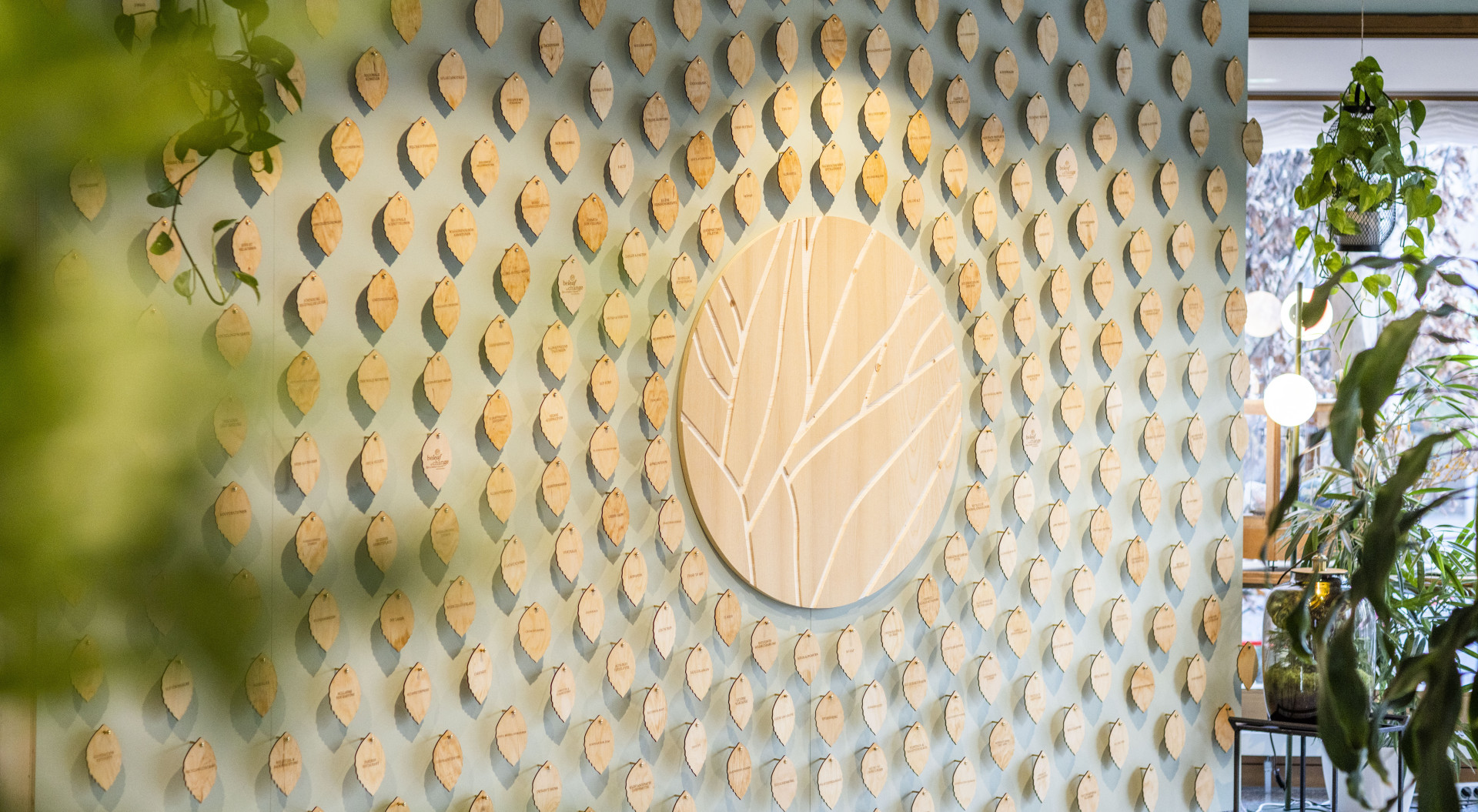
Benjamin Förtsch: Yes, of course. My parents were labeled „green nutcases,” and I might embarrass myself as a speaker today. But the truth is, we can’t save the world alone. I tried for a while – but it didn’t work. That’s why we developed the Wall of Change. There are over 270 measures posted there, ranging from small to large. Each one is an invitation to be inspired, and knowing that there is always more that can be done also motivates me!
Green Pearls®: Final question: If the term „sustainability” has had its day. What remains?
Benjamin Förtsch: Responsibility. Entrepreneurship. And the realization that we are all part of both the problem and the solution.
About the Hotel Luise
Benjamin Förtsch is the third generation of his family to run the Hotel Luise in Erlangen, one of the pioneers of sustainable hospitality in Germany. This family-owned city hotel has been a partner of Green Pearls® for a long time and won the German Sustainability Award in the Accommodation Industry category in 2025. It is one of the first city hotels in Germany to focus on comprehensive circular thinking: materials and resources are used in such a way that they remain in the cycle of use for as long as possible. Washable and durable materials replace disposable products, natural cosmetics come from refillable dispensers, and a microforest is being created in the garden to provide a habitat for plants and animals.